Notebook Structure
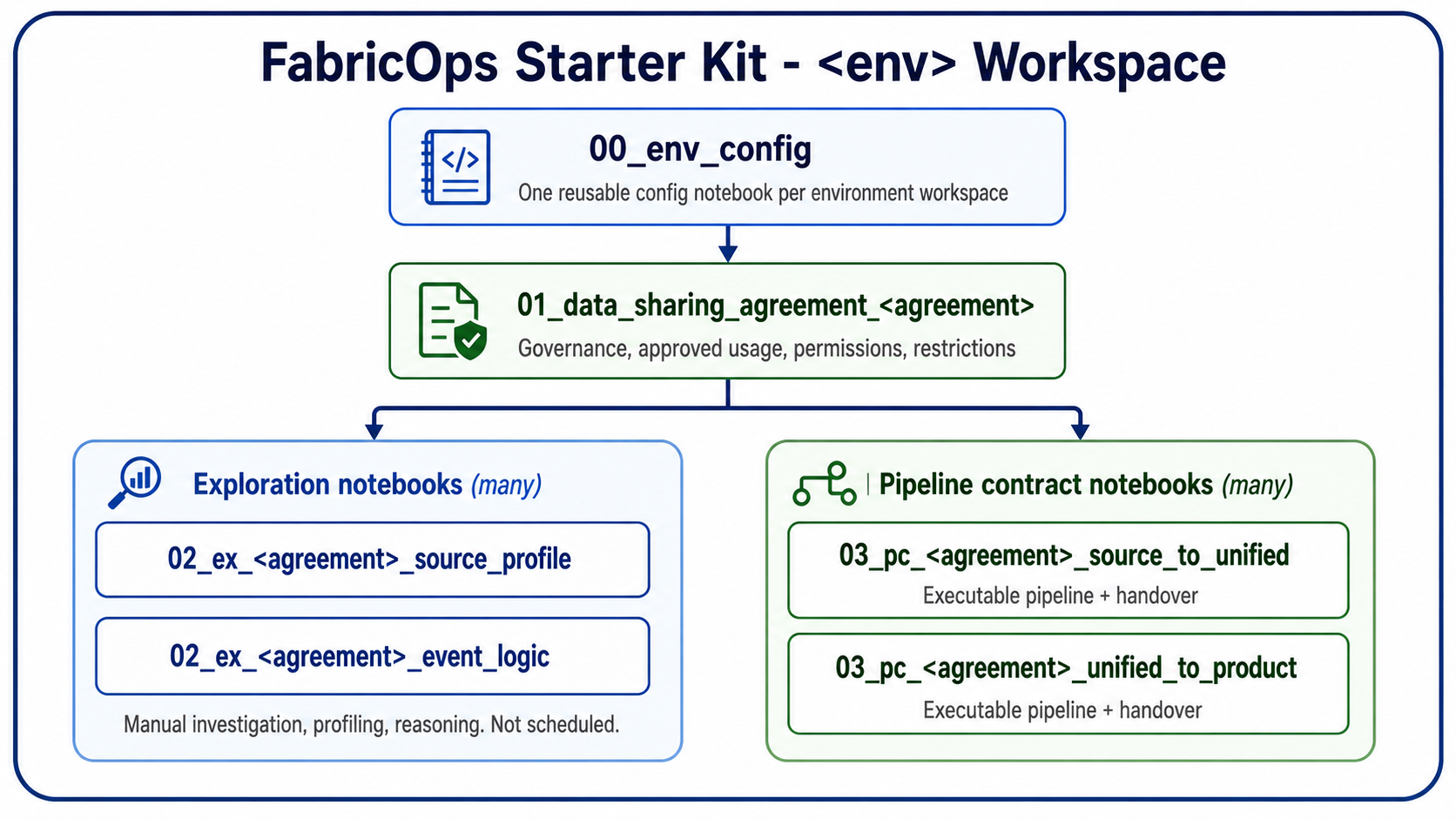
Figure: Notebook organization in a Fabric workspace, linking shared configuration and agreement context to exploration and production pipeline notebooks.
Notebook structure should follow the end-to-end delivery flow, not isolated utility functions.
How the structure supports the lifecycle
A well-structured notebook sequence keeps implementation and governance aligned:
- Purpose: define business intent and approved usage context.
- Config: load reusable environment and runtime configuration.
- Ingestion: declare source inputs and ingest data.
- Exploration/profiling: profile and inspect source behavior.
- Core transformation: build and explain transformation logic.
- Standardization: apply reusable cleaning rules and technical columns.
- Output: publish validated output tables/files.
- Metadata: write run evidence and governance metadata.
- Lineage: capture upstream/downstream traceability notes.
- Handover: produce concise summaries and support artifacts.
Notebook role guidance
- Use shared environment/config notebooks to avoid repeating runtime setup.
- Keep exploration notebooks separate from scheduled operational notebooks.
- Keep pipeline notebooks executable end to end so validation, publish, metadata, lineage, and handover are produced in one governed run.
For architecture boundaries, see Architecture. For full flow sequencing, see Lifecycle Operating Model.