FabricOps operating architecture
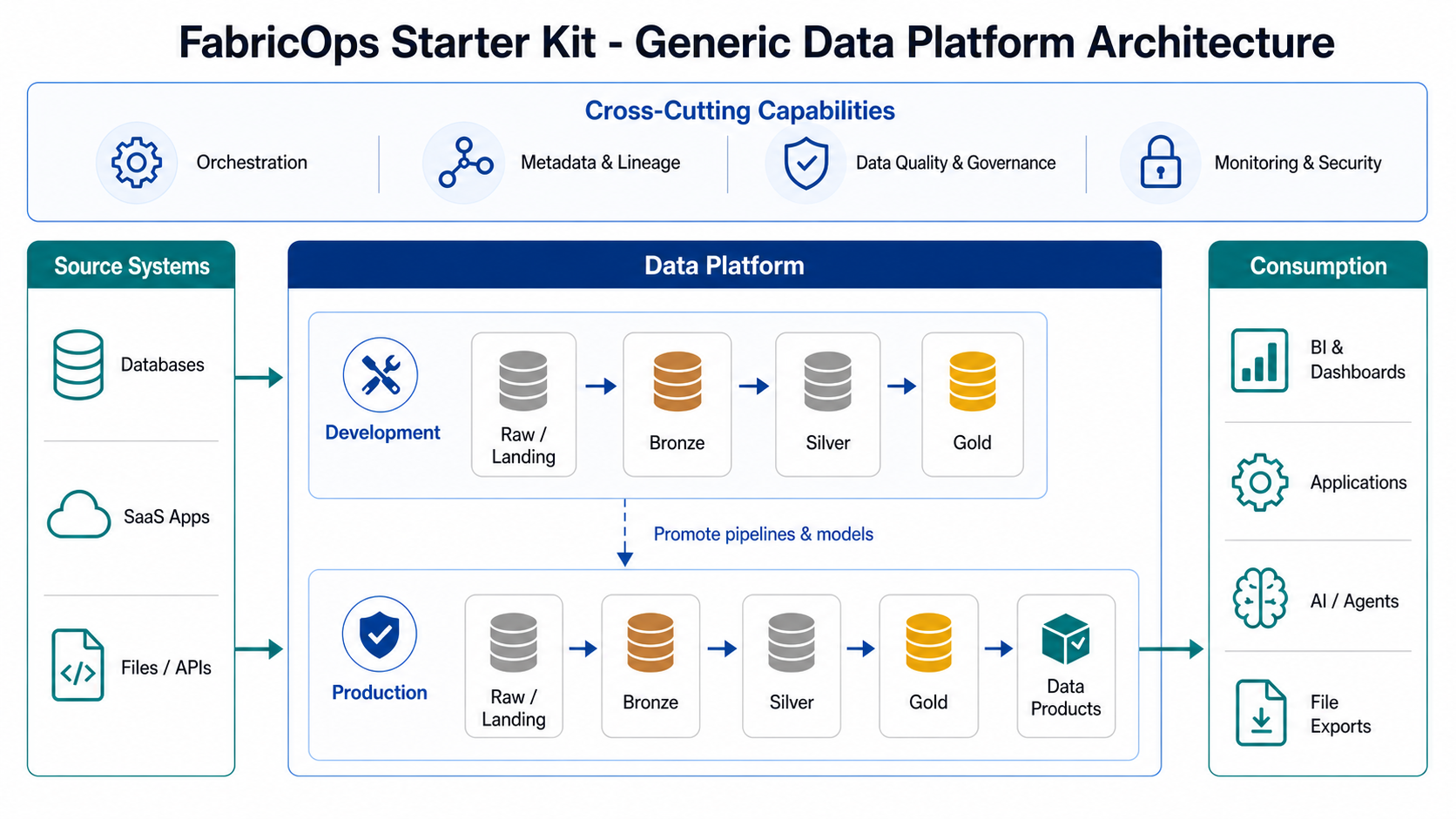
Figure: A generic platform shape with source systems, development and production workspaces, layered data stores, and governed consumption outputs.
Why this architecture exists
FabricOps Starter Kit supports the canonical 10-step lifecycle workflow in Microsoft Fabric where teams move data from source systems to governed, consumption-ready outputs.
In practice, Fabric projects read from and write to multiple lakehouses, warehouses, files, workspaces, and environments. A Fabric notebook usually runs with one default attached item, so reusable configuration and path resolution helpers are needed to make cross-store and cross-environment data movement reliable and repeatable.
Platform shape
The operating shape aligns to four layers.
1) Multiple source systems
Typical source inputs include:
- enterprise lakehouses
- warehouses
- files and object storage
- APIs
- SharePoint
- manual file drops
- other upstream systems
2) Development workspace
Development is where notebooks, rules, profiling, and transformations are tested before release. It uses a three-layer store pattern:
- Source (or Raw) for source-aligned landing data
- Unified (or Bronze/Silver depending on team naming) for cleaning, standardization, and reusable logic
- Product (or Gold) for validated, consumption-ready development outputs
3) Production workspace
Production runs the same Source → Unified → Product pattern so promotion remains consistent and auditable:
- Source / Raw
- Unified / Bronze-Silver
- Product / Gold
This mapping keeps transformation intent understandable across teams even when naming conventions differ.
4) Consumption outputs
Production-ready outputs are consumed through:
- Power BI semantic models, dashboards, and reports
- downstream applications and agents
- exports and integration feeds
- handover packs for support and ownership transition
Cross-cutting controls
Across all layers, the framework keeps execution governed with reusable controls:
- orchestration and run control
- metadata capture
- lineage notes and run traceability
- data quality rule generation and validation
- governance and approved usage context
- monitoring and operational evidence
- security-aware configuration and path handling
Where functions fit
Function-level behavior stays in API/reference documentation, while this page stays focused on platform shape. For lifecycle sequencing and actor ownership, see Lifecycle Operating Model.